



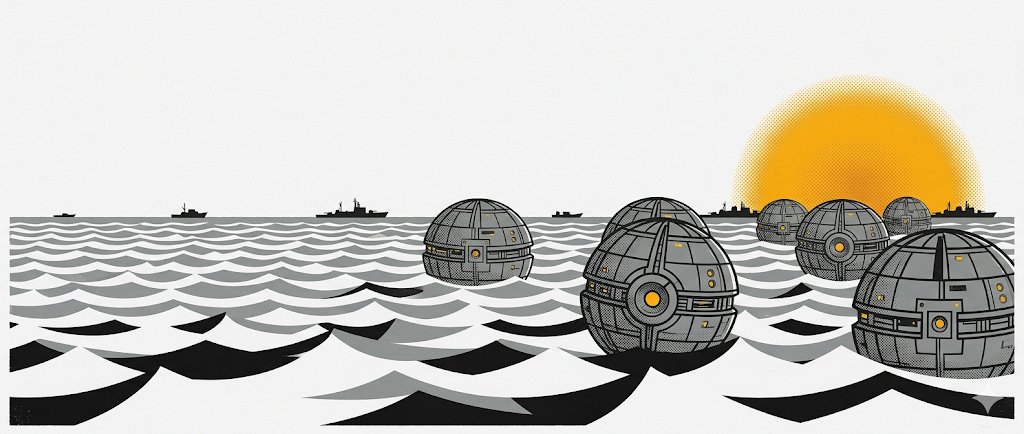
I have always been drawn to the ocean because it is a home to the strikingly sublime— creatures larger and stranger than anything the human mind would think to design, shapes and behaviors that feel imported from some other planet’s biology. I never expected a piece of human-made infrastructure to compete.
But this weekend, like many people who track American deep tech, I found myself staring at images of Panthalassa’s Ocean-2 after CEO Garth Sheldon-Coulson gave his first extended interview on Ashlee Vance’s Core Memory.
Panthalassa is a Portland, Oregon-based startup building floating, self-propelled wave energy converters that double as data centers; each of these “nodes” generates electricity from the ocean’s motion, runs AI workloads onboard, and sends the results to shore via satellite. Although tidal energy plays have come and gone, Panthalassa isn’t harvesting tidal energy near shore. Rather, the nodes are designed to operate hundreds of miles from any coast, in the deep open ocean, where wave energy is orders of magnitude more abundant and consistent. Waves in the southern Pacific, particularly in the latitudes sailors have called the roaring forties and furious fifties for centuries, run essentially without interruption, driven by winds that circle the globe with no landmass in the way or continental shelf to dissipate the energy.
The Ocean-2 is their full-scale prototype, and it is the most arresting object I have seen in a long time. A swollen metallic orb perched on a long, tapering stalk, bobbing alone in open water with no dock, no mooring, or visible tether to anything human. It looks as if a space-age era Soviet probe missed its trajectory, punched through the atmosphere, and settled into the Pacific instead—a kind of Sputnik of the Sea.
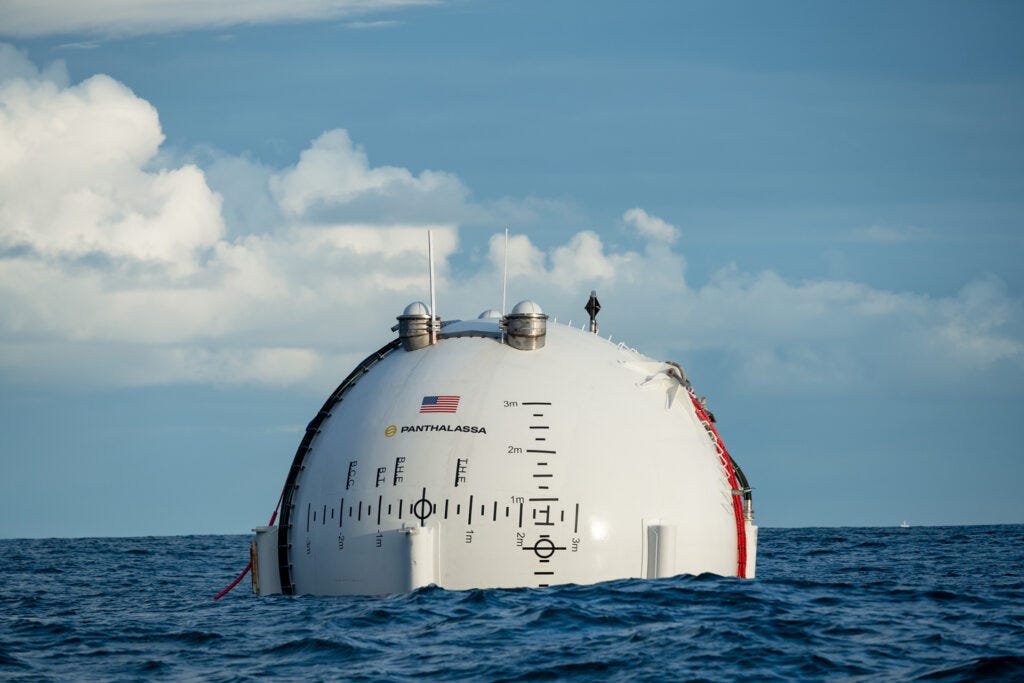
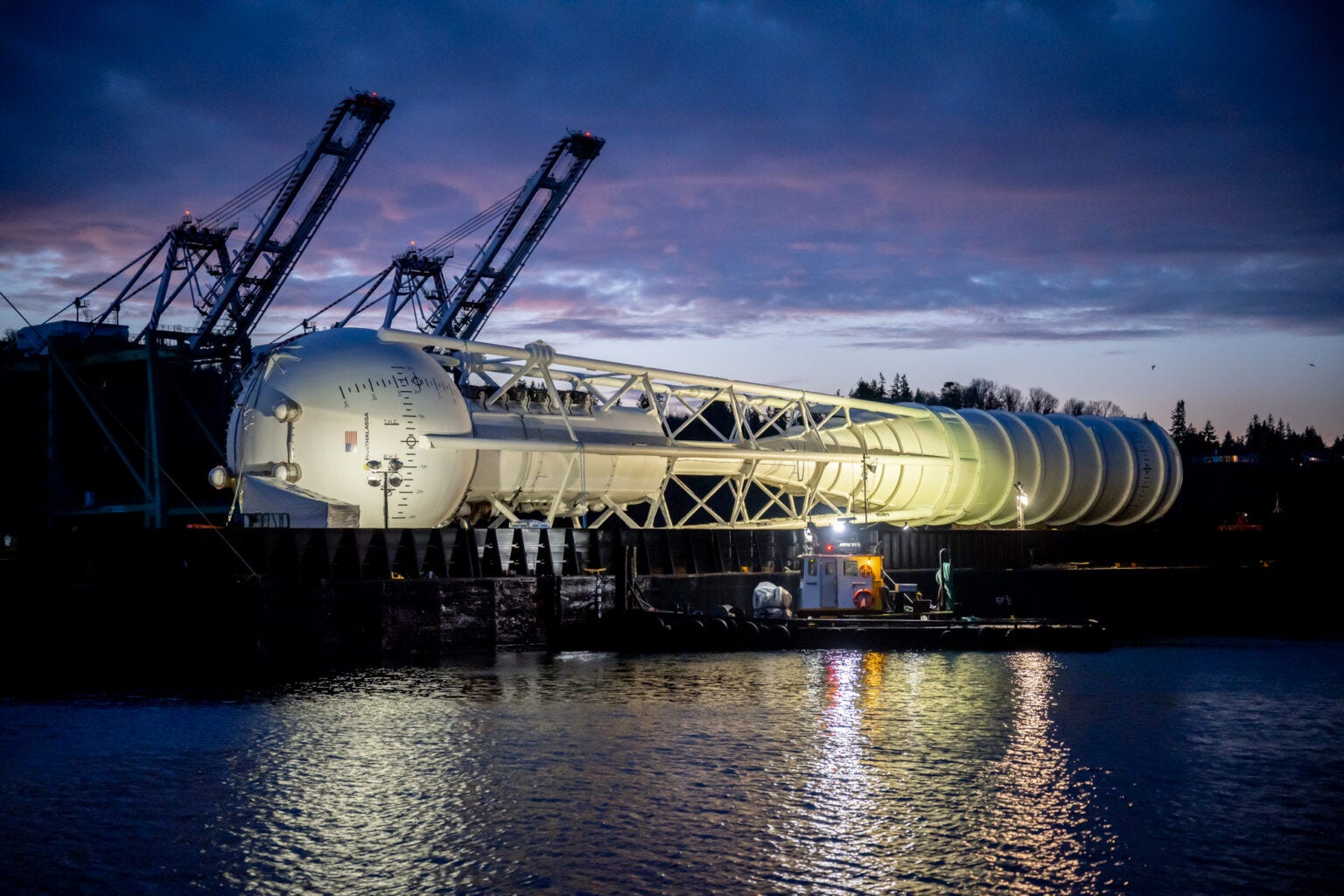
Images of Panthalassa’s Ocean-2 prototype during testing (Credit: Gigascale Capital)
As much as Panthalassa is a technical achievement, it would spur an equally impressive sea change (pun intended) in legal imagination about what the ocean is for. In 1609, the Dutch jurist Hugo Grotius published Mare Liberum—“The Free Sea”—arguing that the oceans could not be owned by any sovereign. The sea was a commons: inexhaustible, belonging to no one, open to all for navigation and fishing. In other words, the ocean was a space you moved through or took things from. It was not a space where you made things.
Grotius was making a commercial argument on behalf of the Dutch East India Company against Portuguese claims to the Indian Ocean trade routes. But the principle he articulated has influenced ocean governance ever since. The International Maritime Organization, which grew out of post-war efforts to standardize shipping safety, regulates the moving: vessel construction, navigation rules, pollution from ships in transit. The International Seabed Authority, created by United Nations Convention on the Law of the Sea (UNCLOS) in 1982, regulates the taking: the extraction of minerals from the ocean floor, which is described as the “common heritage of humankind.”The BBNJ Agreement, the “High Seas Treaty,” is organized around conservation and sustainable use of marine biodiversity. Here, the ocean is a habitat, a collective ecological resource, something to protect.
None of these frameworks contemplates the ocean as the site of industrial production, where raw inputs (wave energy) are converted into finished outputs (AI). Sheldon-Coulson claims Panthalassa can produce electricity at roughly 2 cents per kilowatt-hour, which is well below solar and natural gas in most jurisdictions. A single coastal factory could output a gigawatt of node capacity annually. If those numbers hold, ocean compute becomes one of the fastest paths to building large blocks of clean, cheap power with no grid interconnection queue. The workloads that would run on these nodes would not only be commercially valuable but also become the substrate of national security competition. They would power military logistics, intelligence analysis, autonomous systems, and cyber operations within the decade. These floating towers could become a strategic input on par with semiconductor fabrication or rare earth supply chains.
So what happens then if the legal regime of the high seas, a patchwork of flag state laws and treaties drafted for a world of fishing boats and container ships, suddenly governs the industrial base of AI? Ocean compute presents a new front in the global technological race between great powers, new tools for regulatory capture and procedural warfare, and new avenues for regulatory arbitrage.
We have to talk about China
China builds more than half the world’s shipping tonnage. Panthalassa’s nodes are fundamentally simple steel structures. Sheldon-Coulson has said the manufacturing is an order of magnitude simpler than a car factory, which means the binding constraint on ocean compute at scale is how fast you can produce hulls. Decades of state subsidies, low labor costs, and an integrated domestic steel supply chain that keeps input prices well below what Western yards face mean that no country on Earth can produce hulls faster than China. Additionally, China can provide its own satellite constellation parallel to Starlink, Guowang, which has been approved for 13,000 satellites, along with the BeiDou navigation system. Only about 160 are in orbit today, but China plans to launch 3,600 per year starting in 2028 and they must complete roughly half the constellation by 2032 to retain its spectrum rights. Thus, a Chinese ocean compute fleet would be massive and vertically integrated at every layer of the stack, with no dependency on American infrastructure at any point.
Then there’s the geography. China has spent two decades building port infrastructure across the Indian Ocean and Pacific through the Belt and Road Initiative and the so-called String of Pearls: Hambantota in Sri Lanka, Gwadar in Pakistan, a military base in Djibouti, and extensive economic relationships with Pacific Island states including the Solomons and Kiribati. Ocean compute nodes need periodic servicing and supply chain access, and China already has the coastal logistics network across precisely the regions where wave energy is strongest. If China deploys nodes inside the exclusive economic zones (EEZs) of Pacific Island states with which it already has deep economic ties, the host state provides the legal framework under UNCLOS while China provides the hardware and operates the fleet.
This arrangement would carry a significant procedural advantage over high seas deployment, one that has to do with the new international environmental review regime and who gets to use it against whom.
Procedural Warfare
The BBNJ Agreement, which entered into force in January 2026, has been signed but not ratified by the United States, which means that American companies are not formally subject to its requirements, and no court is likely to hold companies liable for ignoring them. But operating outside a framework the rest of the world recognizes has practical consequences. The treaty gives states procedural tools, such as environmental impact assessments and marine protected area designations, whose force doesn’t depend on American compliance. Their purpose, in this context, isn’t to produce a binding legal judgment against Panthalassa. Instead, they might produce formal international findings that become the basis on which port states that are BBNJ parties restrict servicing access, insurers price risk, and trading partners impose conditions.
The BBNJ requires environmental impact assessments for new activities on the high seas that may have a significant effect on the marine environment, with floating energy installations explicitly listed as the kind of novel activity the treaty’s drafters had in mind. On its face, this seems reasonable. But it’s worth noting what Panthalassa’s nodes actually do to the ocean, which is remarkably little. They don’t extract anything from the seabed or discharge pollutants in any traditional sense. They don’t anchor, dredge, or trawl. They just float on the surface and convert kinetic energy into electricity.
The problem is that the treaty’s threshold for triggering a full environmental assessment is low and deliberately vague. An activity qualifies if it may have more than a “minor or transitory effect” on the marine environment, or where the potential effects are “unknown or poorly understood.” That second clause is key, because for a technology this new, there will always be insufficient knowledge. Nobody has studied the long-term ecological effects of ocean data centers, because until now they did not exist. The absence of evidence of harm gets reframed as a justification for precautionary review, and the review process can take years. Any party to the agreement can raise concerns about another party’s assessment, and the scientific and technical body can request additional information or recommend modifications. The treaty does not impose fixed deadlines on the review process.
Therefore, a coalition of states that wanted to delay a competitor’s deployment wouldn’t need to prove the nodes cause harm. They’d just need to keep asking questions: How do the nodes’ thermal discharge affect pelagic ecosystems? Could there be electromagnetic interference with migratory species? Are microplastics shedding from their hulls? Additionally, marine protected areas, adoptable by three-fourths majority vote, could be used to zone American ocean compute out of the best wave energy regions entirely.
In contrast, under UNCLOS Article 56, the BBNJ doesn’t reach EEZ-based energy production. China, working through sympathetic member states, could use the BBNJ framework to demand rigorous and repeated assessments of American deployments while its own nodes operate freely inside Tongan or Kiribati waters a few hundred miles away. The environmental concerns would be identical, but the regulatory exposure would be completely asymmetric.
Flags of Convenience & GPU Pirates
Strategically sabotaging ocean compute might be the most salient governance problem in the context of the AI race. But at a more basic level, the legal architecture of the high seas makes AI harder for any country to regulate, including the one whose companies built it. If the United States wants ocean compute to develop— and it should—it needs that infrastructure to remain under American law. The principle of maritime law at play here is that the laws that a floating object is subject to the laws of the country whose flag it flies. This is laid out in UNCLOS, and even though the United States has never ratified the treaty, it accepts this framework as customary international law.
Panthalassa is an American company, but its nodes can be registered anywhere. Going flagless isn’t a viable option as an unregistered node would have no legal nationality, thus no right to enter any port for servicing and no protection against boarding by any passing navy. Most of the world’s commercial tonnage is registered in Panama, Liberia, and the Marshall Islands, not because those countries have great ports but because their registries are cheap and light on enforcement. These are three examples of what are officially called open registries, but which are more often referred to as “flags of convenience.” The system was built for shipowners who wanted to avoid labor standards and safety inspections. Ocean compute would inherit the same logic, with companies seeking out jurisdictions with favorable AI governance.
American AI laws would certainly apply to models that serve end-users in the US regardless of where they train or inference, but the enforcement weakens significantly once AI’s physical infrastructure leaves American jurisdiction. Laws like California’s SB 53, New York’s RAISE Act, and the proposed BIS reporting rule proposed under Executive Order 14110 rely on regulators’ ability to verify the size of a training run and the physical measures taken by companies to secure model weights. But spin up a subsidiary, flag the nodes in Vanuatu, run the training offshore, and the verifiability of these reports—the ability to inspect hardware, audit power usage, cross-reference chip counts—vanishes into the Pacific.
Similarly, U.S. chip export controls become much harder to enforce once chips are stored on uncrewed infrastructure five hundred miles from land. We don’t have to speculate on what evasion at sea looks like because we’ve already seen it happen with oil: Russia’s shadow fleet—now over 3,000 vessels—moves billions of barrels of sanctioned crude annually using mature and well-documented methods. They conduct ship-to-ship transfers in open water, breaking the chain of custody so that oil loaded in Novorossiysk arrives in India with paperwork suggesting it came from somewhere else. Additionally, tankers spoof their AIS transponders or go dark entirely.
Analogous techniques work for chips, and in some ways, the problem is worse. Advanced GPUs are smaller, lighter, and more valuable per pound than crude oil. An Nvidia H100 weighs about three pounds, is worth roughly $30,000 on the open market (and considerably more where supply is restricted), and can fit in a backpack. Additionally, identifying the theft or illicit changing-hands of chips in the remote, open ocean is difficult. Nvidia’s geolocation system is basically an internet ping that depends on chips’ continuing to communicate with Nvidia’s servers. If a chip stops phoning home, it effectively disappears from view. So a node could deliberately go dark under the auspices of a storm and be written off as damaged or lost while proverbial GPU pirates covertly move the valuable hardware elsewhere. Additionally, a chip on a node in the Pacific may appear to be where it is supposed to be, but that does not tell you whether the tracking system is still working properly, whether someone tampered with it, or whether repairs or part swaps were accurately recorded. This is also true of terrestrial data centers, but corroborating any of this would require physical inspection, which is difficult in the middle of the Pacific.
Mare Computum
Grotius looked at the ocean and saw a void, a commons defined by its emptiness. Panthalassa looks at it and sees a power plant. The ocean is about to be full of things that matter, built by people moving faster than the institutions around them, in a space that the law has always assumed would stay empty. It won’t. And the gap between what the ocean is becoming and what the law imagines it to be is not a reason to stop building. It is a reason to start governing and competing, thoughtfully and quickly. The countries and companies that understand that will shape what comes next. The ones that don’t will find that the oldest commons on Earth has new landlords, and that nobody asked for their input on the lease.