



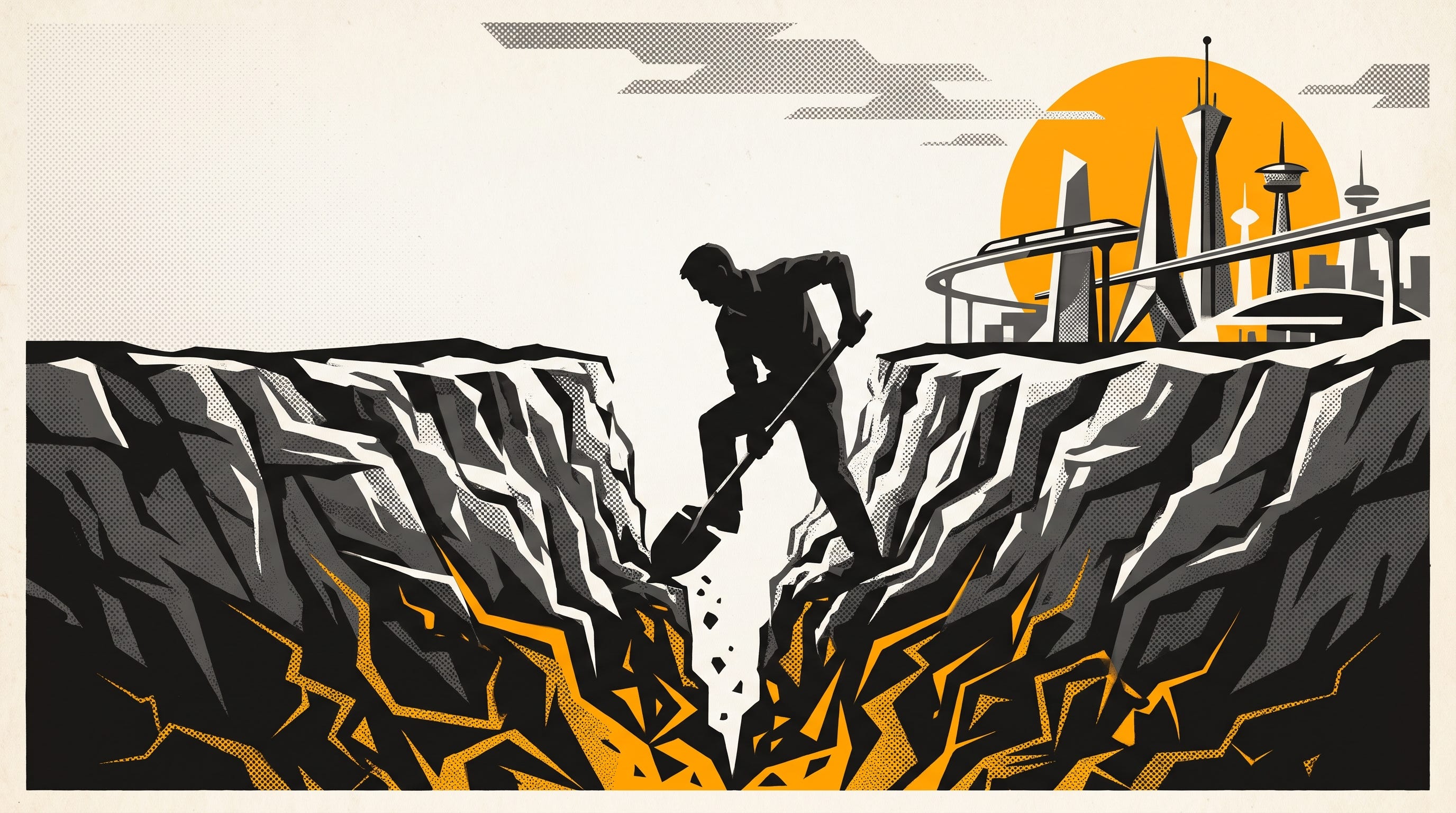
On its dystopian surface, Digger seems little more than a box-office flop with a done-to-death message: the son, or, better yet, nephew, also rises. Gregory Clark’s 2014 history of social mobility—or lack thereof—traced the stubbornness of surname supremacy over eight long centuries. It’s a cavalcade of nepotism grimly reinforced in Alejandro González Iñárritu’s soggy and sprawling puzzle box of a disaster movie. Or so it seems…
Herewith—for those scared off by the establishment critics’ shrieks of dissatisfaction with the film, over something they could not quite, tellingly, identify or name—the plot, to make Iñárritu’s deliberately long story short. On with the spoilers: Latter-day dynastic heir Kenny Rockwell (Jesse Plemons) perpetuates his family’s grip on monied power by serving cathartic clapter theater about the downfall of his infamous uncle Digger (Tom Cruise) to the bedraggled survivors of said uncle’s catastrophic resource extraction. Driller! Digger! Get it?
Anyway, the big half-sunken city’s ticket-buying public pack sold-out theaters for a night’s escape of sorts, dutifully filing back out when the curtain falls into the Europoor wasteland that awaits: military police, drone patrols, flotsam, jetsam, hooliganism, graffiti, the works.
Most of what we see in Digger is the tech rehearsal for the latest production of the play, Fossil Fools. The stagehands sweat, the director frets, and the actors stress—not least Cruise himself, who, slipping seamlessly between acts into the role of the workaday thespian playing Digger, chews his nails with increasing desperation as the latest superstorm imperils his traveling daughter’s life. Lucky for the whole family, who but Kenny himself, the family biz now stretching from entertainment to more kinetic operations, can pull a few strings from the wings?
But we are meant only to catch a whiff of the dizzying implications of Kenny’s tacticool sidebar, which rescues the troubled rehearsal at the crucial moment and keeps Fossil Fools, not to mention the canny extant Rockwell clan, deep in clover under pop-culture cover. The very theatrical distraction from what lies beneath is none other than the cartoonish Digger onstage, depicted as himself a relentless distracter from the headlong disaster into which he plunged the developed world. Whenever in the slightest jam, he resorts to his signature spiel about how his granddad—or was it his great granddad?—managed to first strike oil. Obliged to bury his brother with no more than a simple shovel, after the deed was done, well, he kept right on digging. Got yourself into a hole? Only one thing to do…
It all seems roughly on the level of the classic comeback to “no shit, Sherlock”—keep digging, Watson. But, ironically enough, that’s exactly what Iñárritu wants us to do. In the show-stopping 10-minute one-take monologue at the centerpiece of Digger (and Fossil Fools), the exceedingly Dubya-like tycoon embraces the role of scapegoat only to turn it around on the irate European parliamentarians encircling him. To blame for the cataclysm is, actually, “every one of you, no matter how conscientious you pretend to be.” After all, it’s they who want cheap fuel, air conditioning, “cheap tickets to Mallorca” and “two-day delivery of shit that you don’t need.”
Nodding to The Matrix, he observes the assembled “want to carve into a good steak”; like Tyler Durden in a skinsuit, he admonishes their base desires for the plentiful energy to “charge up them cellphone batteries” and “ask AI to solve the very same disasters that it’s fueling.” The real criminal, says Digger? The human heart. We’re on the highway to hell, he tells the on- and offscreen audience, because “you want freedom—freedom to bask in the comfort of your unsustainable lives!” A mic drop moment—or so, once again, it seems. For the obvious question Digger’s monologue calls forth is conspicuously unasked and unanswered by the film’s characters onstage and off.
Why?
Why do so many people want so much energy to do so many different things? Just what is the tremendous, nigh-irresistible allure of life’s fleeting worldly pleasures great and small? A pull so deep and intense that even the possibility—the probability—of an unpayable bill eventually coming due is not remotely enough to make you, yes you, just stop—even just pause the personal carnival train of earthly delights?
It’s a question and a logic instantly recognizable to any gambling addict (as Dostoyevsky, for one, knew well). Any anything addict knows it in their bones. But while Digger drives us into a moral cul-de-sac where we’re to blame because we desire, Digger digs deeper, to the substrate of the heart—where, as Rene Girard laid bare in Deceit, Desire, and the Novel, our desires are hardly the end of the moral calculus, but merely the beginning.
In one of life’s uncanny coincidences, there’s no indication Iñárritu was influenced by a certain webcomic by Ursula Vernon also named Digger, a Hugo award-winning series (2003-11) featuring a titular wombat whose response to the crumbling of the world’s foundations under the weight of ancient curses is indeed simply to dig—shoring up the earthen works with her no-nonsense engineering. Where Iñárritu’s Digger tangles manipulatively with Dr. Ganesh (Riz Ahmed), his environmental safety chief, Vernon’s Digger deals with a talking statue of Ganesh the same way she handles all the divinities and supernatural beings damaging the land: the steady application of what a follower of Richard Rorty or John Dewey might call ethical pragmatism. Even the demon-coded Shadowchild is the beneficiary of Digger’s paradoxically idiosyncratic communitarian values.
Vernon’s vision of self-directed desire unlocking secular grace is utterly at odds with Girard’s anthropology of the sacred—and, it appears, Iñárritu’s. The temptation to operationalize Girard always harasses his acolytes, but the theorist’s deepest insight into mimesis directs readers away from the affairs of this world. “What Jesus invites us to imitate,” Girard writes in I See Satan Fall Like Lightning, “is his own desire, the spirit that directs him toward the goal on which his intention is fixed: to resemble God the Father as much as possible.” Mimetically, “Satan likewise presents himself as a model for our desires, and he is certainly easier to imitate than Christ, for he counsels us to abandon ourselves to all our inclinations in defiance of morality and its prohibitions.” The insight is that our propensity to choose obsession with the objects of other people’s desires instead of devotion to the object of Jesus’s desire arises from the apparent discomfort and difficulty involved in the latter.
For the Christian, whose way of life is to follow Jesus in this fashion, it is true, as St. John of Kronstadt warned in his spiritual autobiography, that “the kingdom of heaven suffereth violence. You will not be able to work out your salvation without forcing yourself.” But if Christianity reserves a certain grace for those living easily in ignorance of the Gospel, the hardest and most punishing path is foretold for those who knew better than to squander soul and energy away on distractions forged in the fire of others’ avoidant passions, but did it anyway, even unto death.
That’s exactly—as at least some of Iñárritu’s audience will hopefully notice—what the filmmaker has Digger Rockwell and his faux-Christian inner circle demonstrate, from their first scenes to their last. President Compson (John Goodman) and his kept pastor, Rev. Nathaniel Moore (Stephen Wright), brandish the Bible like a pagan idol and yap the “right” words in performative prayer; none of it, of course, is enough to stave off catastrophe. At the climactic moment of Fossil Fools, Digger himself prays for the miraculous replenishment of his meat locker with a panicked sincerity straight out of Jesus’s admonition that “not everyone who says to me, ‘Lord, Lord,’ will enter the kingdom of heaven” on the day of judgment; of course, his sacrifice of praise is unacceptable, and soon—in the play, if not necessarily in real life—Digger opts for the ultimate distraction, that of Judas at the end of his rope.
Digger being sci-fi, there is in these anthropological and spiritual lessons a cybernetic one as well.
For most people invested in these matters, the dominant Girardian wager on cybernetically forestalling apocalypse is obviously Peter Thiel’s. Palantir’s counterintuitive insight is that ensuring the nations can continue to fight wars is actually net harm reduction. To prevent the total consolidation of temporal power and human authority into one world regime—the reign of the Antichrist who delivers more health and safety than even the Lord has done—Palantir’s sovereign ontology-as-a-service keeps the crucial set of nations pre-Christian enough in their values to manfully reject the Antichrist’s universal basic safe space.
Remarkably, Thiel’s schema chimes with the logic of that other French genius, Jean Baudrillard. “If every strategy today is that of mental terror and of deterrence tied to the suspension and the eternal simulation of catastrophe,” he writes in Simulacra and Simulation, “then the only means of mitigating this scenario would be to make the catastrophe arrive.” Echoing Girard, Baudrillard stresses that “the system is running on a concept of preventive catastrophe... it purges itself of all its internal negatives, all its waste, and in doing so it creates a vulnerability so absolute that it becomes catastrophic in its own right.” But Baudrillard’s corrective is hardly to shore up de-Christianizing nations susceptible to the Antichrist with nationalist conservative values.
To the contrary, Baudrillard insists that the event horizon of the simulacrum is already closed, the catastrophic implosion of the world system is already in progress, and the inescapable aftermath will slowly transition everyday life from a hypernormal state of perpetual emergency to a gigafried gray reset. Baudrillard highlights what Thiel prefers to occlude: because only technique can strongly simulate a substitute for Spirit, the totalitarian safety system can only run on ever more escalated technologization—a strategy that must implode because the last remaining threat to safety must necessarily be that posed by the complete consumption of all subjects by one, unitary, total technological object. In this sense, for Baudrillard, cybernetics is already useless; the only system that can now be useful is the most useless one: pataphysics, the science of imaginary solutions.
But another way of saying this, perhaps, is that the seeming superintelligent obsolescence of cybernetics—wherein “what such machines offer is the spectacle of thought, and in manipulating them people devote themselves more to the spectacle of thought than to thought itself”—can only be salvaged pataphysically, by the introduction into cybernetic control systems of the one thing that would logically seem to be most incompatible with cybernetic controls. This is what Digger, in its relentless elaboration of the unceasingly unsustainable and the perpetually imploding, silently recommends: neither the fake Christianity of performative prayer nor the national-conservative values of calling in the airstrikes and nepotistic resilience; neither the frenetic conversion of excessive energy into mimetic distractions nor the rationing of depleted spiritual power for rote moments of canned catharsis. Neither the turbo-American Digger regime nor the post-apocalyptic bog of global Europoverty provide a salubrious model of technopolitical governance.
Is Iñárritu’s not-so-secret third thing—whether he knows it or not—merely the reintroduction of at least some spiritual authorities we can trust into the upper echelon of technological system controls? Both first-wave cybernetics (which views the system as an observer) and second-wave cybernetics (which views the observer as a component), in agreeing that the best we can do to retain control over systems that outstrip our own capabilities to observe, orient, and act, is to retain, against all temptation, the responsibility to decide, reject the possibility that machines or truly responsible human decisionmakers could ever assent to human spiritual authority. Like both Girard and Baudrillard, however, Iñárritu presents a narrative in which the irruption of the seemingly unworkable into failing systems reveals why the systems which spare no expense of energy on the pursuit of ever-higher performance are those which most reliably and spectacularly fail.
There are more than a few conceivable ways to structure technological advancement under spiritual authority, to which the faithful among the world’s religions will doubtless soon give voice. From a Christian point of reference alone, orthodox, apostolic, apostatic, schismatic, syncretic, heretical, gnostic, and idolatrous approaches are all to be expected. But, notably, in today’s apocalyptically inflected superintelligence industry, Anthropic stands alone among its peers—with the conspicuous exception of Palantir—in wagering that the continued viability of acceleration inescapably hinges on the role of spiritual authority wielded by human leaders. Given the political unpopularity of both the militaristic and the altruistic twists on the bet, such leaders may increasingly slip away from political life and institutions, clustering instead within technological and religious ones. As an intermediary of sorts between the political and the technical, policymaking institutions are surprisingly well positioned to ensure that spiritual leadership does not retreat from governance, leaving a beleaguered Western world to choose from among the cursed rotation of Dr. Ganesh, Rev. Moore, and, of course, Digger himself.