



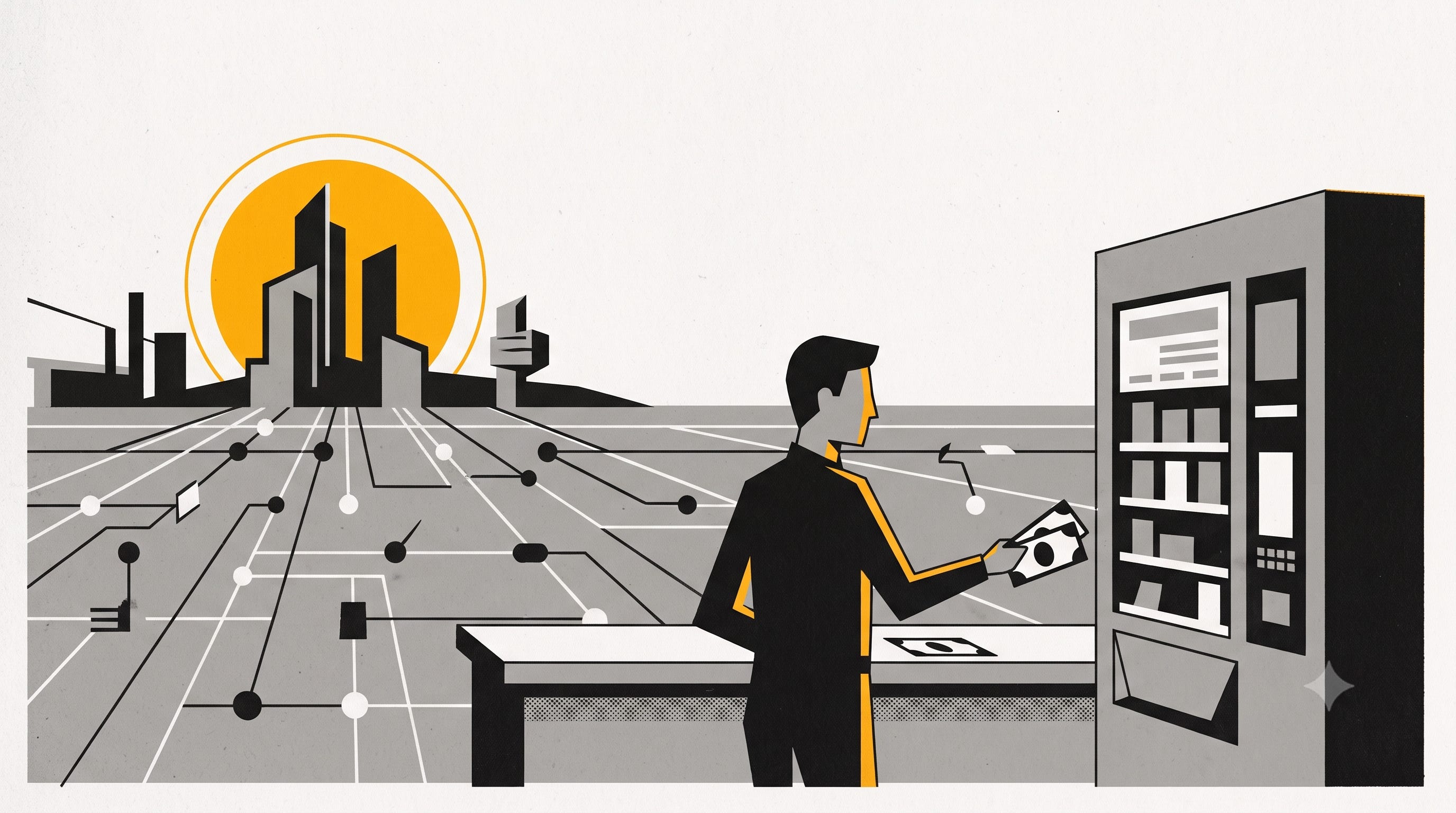
Among the curiously outsized contributions of Quakers to modern economic life, fixed prices stand apart. Where marketplaces used to be marked by haggling, discrimination, and the mood of the seller, Quakers posted prices. What you saw was what you paid, and so Quakers earned a reputation for being honest dealers. They offered no tricks and little need for written contracts. They had so little interest in manipulation that they revealed their hand, and their price tags, up front. The trust they established drove transaction costs near zero, and enabled the beginnings of modern free trade.
In America, our social cohesion depends not on a common religion, heritage, tongue, or tribe, but at least in part on this Quaker-inspired innovation. When the Industrial Revolution ushered in nationally branded stores, it also cemented fixed prices as a fixture of American commerce, reinforcing what would become a quintessential American value. No matter who you are or what you believe, your money is no more or less valuable than the money of the guy ahead of you in line.
Fair dealing in trade as a core component of our social contract has its downsides. One such disadvantage is the lack of a cohesive moral vision for societal flourishing, a flaw on full display as we fail to articulate a common American understanding of nearly anything of import. And yet, equality under the dollar also underrides America’s cardinal virtues. We may have built a temple of money, but upon it rests more admirable spires, those of tolerance, and equality. The history of American progress can very well be told through the expansion of who could participate in the market at no additional cost: freedmen, women, immigrants, Catholics. It may not be the perfect societal foundation, but it is ours.
AI is about to completely upend this equality under the dollar. Sort of.
What is algorithmic price discrimination and is it actually happening?
Defining algorithmic price discrimination is harder than it seems, a problem we will return to later. For now, we can consider it as the use of algorithms to sell identical or near-identical products at different prices under identical or near-identical cost conditions. That is to say, it is anathema to the tradition of Quaker posted prices. It’s worth noting that we have long tolerated lots of price discrimination. Few take umbrage with senior rates at movie theaters or discounts for bulk purchasers. Algorithmic price discrimination, sometimes referred to as first-degree discrimination or surveillance pricing, is where it starts to get uncomfortable, and that’s where AI comes in.
Historically, the ability to accurately assess the maximum amount a given consumer is willing to pay for a product based on hyper-personal characteristics was the stuff of textbooks. For decades, the best real world example was college tuition, where students submit reams of personal information before a university tabulates the final price tag for a specific student. More recently, the market for personal data has allowed companies to further target ads and coupons. Occasionally, this borders on the downright creepy, as when a father berated his local Target for mailing his teenage daughter coupons for baby gear, only to later discover the retailer knew of her pregnancy before he did. This is only the tip of the iceberg compared to near term possibilities. Imagine a world where cameras scan your face upon store entry, prices change as you walk down the aisles, then change again when you place an item back down, as the algorithm updates its assessment of your willingness to pay. Or consider one where prices remain fixed until the self-checkout populates discounts, marketed as loyalty points, that are curiously different from the shopper the lane over, who shops there with the same frequency as you and purchases the same quantities.
Although sellers have always segmented the market to charge sub-populations differently, this type of individual targeting doesn’t sit well with most people. But is it actually happening? Although experts are divided on whether algorithmic pricing can lead to tacit collusion among sellers, there is growing consensus that AI is increasingly capable of predicting a consumer’s willingness to pay. In 2019, Kroger experimented with video analytics to promote personalized ads and coupons based on customer demographics before ending the pilot program (though it still uses and sells data about customers to that effect). Since then, technology has improved and store experimentation has expanded, prompting the FTC under the current and previous administration to ramp up investigations into algorithmic pricing.
Great, let’s ban it!
Several states have proposed legislation opposing algorithmic discrimination, with Maryland recently passing the nation’s first restrictions on grocery stores employing the technology. However, in their fervor, these laws tend to fall into a few pitfalls that hamstring their efficacy.
Firstly, outlawing price raises based on personal characteristics is both overly broad and insufficient to address the harm. Most obviously, personalized discounts offering lower prices can achieve the same effect, a low-hanging loophole. Beyond this, the same personal data can be used legitimately or discriminatorily. Consider location data. Most stores base prices on supply and demand considerations for each specific locality in which they operate. When Staples.com prices staplers based on the cost of shipping and the number of nearby rival stores, it is digitizing the traditional price considerations of supply and demand. When Princeton Review, despite the same marginal costs, charges more for online SAT resources in zip codes with higher percentages of Asians, it is considering demand differences based on demographic data. This is different still than if a store, knowing I have travelled from a poorer neighborhood to a wealthier one to buy a necessary good somewhere with lower operating costs, charges me the same high price I’d find in my own neighborhood. The same data, employed differently, is more or less surveilling, more or less personal, more or less discriminating against protected classes depending on the broader context. Legislators need to clearly distinguish when data use is discriminatory and when it is fair game.
Secondly, not all markets are the same. Algorithmic price discrimination is easiest where consumer power is weakest. While many state and federal proposals focus on grocery stores, any city dweller can attest that the resale market for groceries and pharmacy wares is alive and well. Nothing prevents someone who gets charged less from selling goods at a profit to people who would otherwise pay a still higher price from the original seller. This does not mean price discrimination is not still possible, but it is less so than for an Instacart delivery or a software license linked to your IP address. Digital markets often limit arbitrage, and their prices are the most natively driven by consumer data rather than product cost.
Markets with only a few dominant players also have an easier time discriminating, since the consumer has fewer alternatives. Anthropic pricing your subscriptions based on the inane data Claude has collected on you is the perfect storm: one of a few sellers sets the price for a digital good with no arbitrage capacity. Your consumer surplus and welfare drops, the producer’s rises. Oddly, the Maryland law exempts subscriptions while few state laws focus on digital markets.
Lastly, dynamic pricing can masquerade as algorithmic discrimination, but the market effects differ and they should be treated differently. Dynamic pricing refers to near continuous price updates based on market conditions, sometimes aided by algorithms. At least in theory, dynamic pricing better reflects the equilibrium price for the market at that moment, resulting in less dead weight loss and more producer and consumer surplus. We have long accepted that gas stations, despite selling an essential good, change prices fairly often based on barrel prices, weather, time of day, and nearby competitors. Like gas stations, grocery stores have very low margins and need to accurately reflect market dynamics to stay afloat. Their thin margins reflect generally competitive markets, and their goods can be resold. When legislators lump dynamic pricing in with algorithmic pricing, they score political points by seeming pro-affordability, but their market distortions often distract from the real problem.
Nonetheless, if each instance and person marks an unrepeatable point in space-time, the market becomes so specific that the lines between dynamic and discriminatory pricing blur. When a friend hails a dramatically cheaper ride seconds after you from the same ride share app, it’s not clear whether real-time supply fluctuations or personal characteristics made the difference. When Amazon alters prices millions of times a day, it is hard to determine what is dynamic and what is discriminatory. Meanwhile, airlines and insurance companies reliant on outside technology may not even know what factors ultimately determine their prices. From a regulatory standpoint, we’re left with an important balance to strike. Dynamic pricing on its own should not be universally vilified, but it also shouldn’t disguise discriminatory pricing.
This leads to what may well be the hardest part of legislating algorithmic price discrimination: proving it’s happening. In an age where firms become increasingly unable to explain their prices because they have offloaded pricing strategies to AI, discrimination may become easier and more unprovable. The easy solution is to expand the “disparate impact” judicial theory that applies to markets like housing and employment, wherein the mere fact prices differ among protected classes violates the law. Yet, such an expansion would ignore basic economic principles that help both consumers and producers. Think of Instacart delivering to food deserts. Even with well crafted legislation, the harder task will be for courts to establish thoughtful legal tests that consider use, impact, intent, number of competitors, and targeting without relying too heavily on any one of those to prove malfeasance.
Why this matters
As with much tech policy, feelings about algorithmic price discrimination do not align neatly with political labels. The left praises it for its ability to make markets more equitable and get goods into the hands of those who would otherwise not afford it. The right champions its market efficiency. The left derides it because companies can use it to surreptitiously or unknowingly discriminate against all manner of protected classes. The right opposes it because charging exactly a consumer’s willingness to pay disincentivizes earning more money, since you can buy the same good for a cheaper price if your smaller nest egg means you value it less.
As models improve, the capacity for algorithmic discrimination under certain conditions increases by the day. Depending on who deploys it, that could make America more equitable or quietly more oppressive; it could make our markets more efficient or it could stagnate innovation while artificially enriching company coffers. Regardless of its deployment, it will in some real sense erode our common understanding of American economic equality. This conviction need not lead us to knee-jerk policies or panic us into believing that such discrimination is universal, but it should motivate us to remain vigilant. As complicated as legislating well against algorithmic discrimination is, vigilance may go a long way. Although informed consent hardly moves the needle for website cookies, consumer outrage at inexplicable pricing differences has successfully changed companies’ policies. A good first step for legislators, then, is demanding pricing transparency. Perhaps companies will learn not to test the resolve of Americans who have long fought for equality in the marketplace.
You are right that price discrimination can be good when it is fair and transparent, and that transparency is a good first step toward fairness.
To see how win-win and fair price discrimination can work and change the nature of commerce, consider the FairPay framework.
--An updated overview that factors in how AI can make this practical: https://www.fairpayzone.com/2024/11/fairpay-innovative-win-win-customer.html
--A list of key pieces, both theory and practice: https://www.fairpayzone.com/p/more.html
--Some key elements that enable fairness: https://www.fairpayzone.com/2019/07/the-elements-of-next-gen-relationships.html
--More on the history of the price tag and how it distorted commerce, plus link to an HBR article on FairPay: https://www.fairpayzone.com/2014/12/so-last-century-its-time-to-end-tyranny.html