



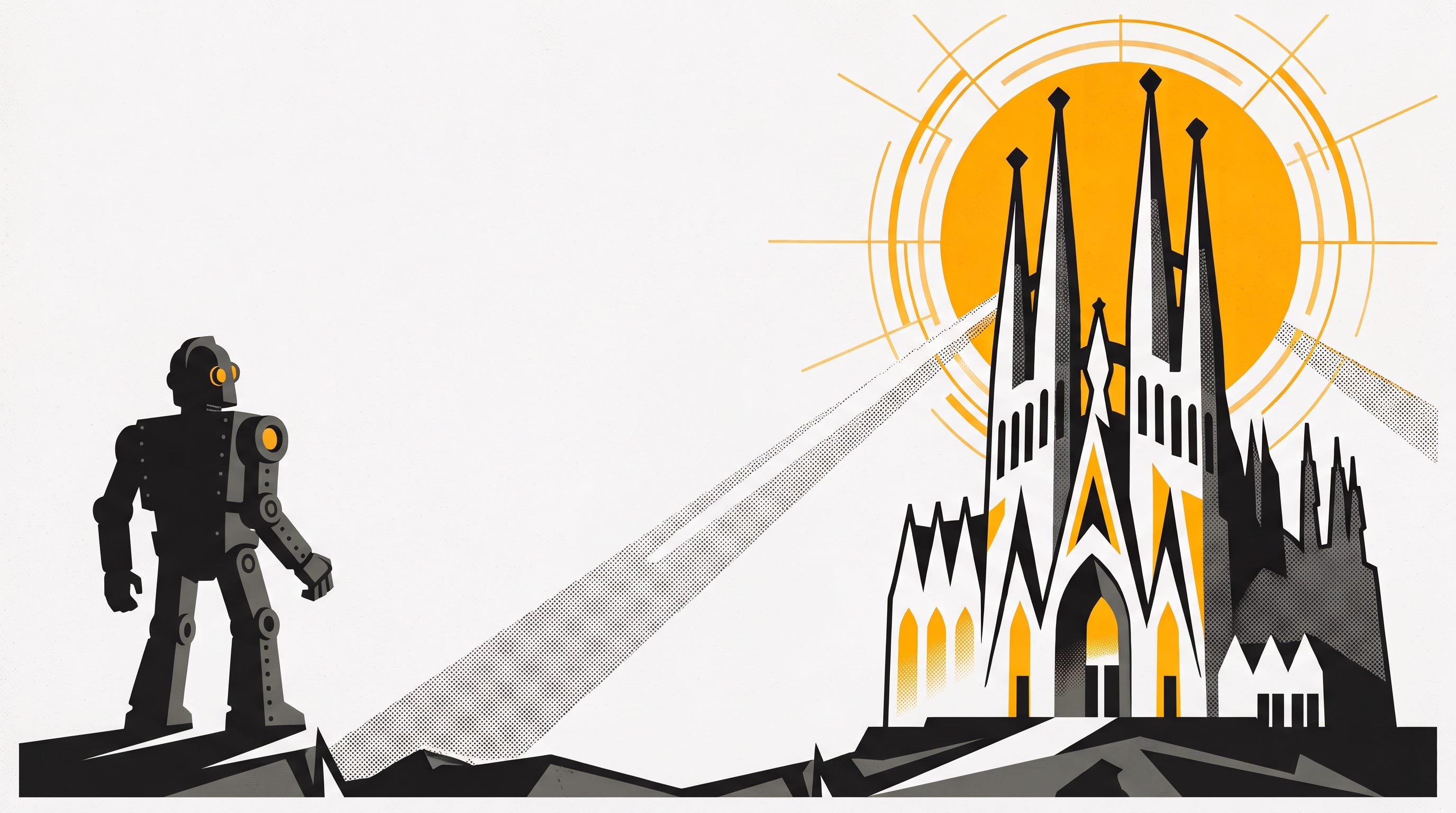
There’s not much to hide in the genealogy of the clanker. The term, in vogue among Gen Z-ers and Alphas as an anti-machinic epithet, gained contemporary currency through the mid-2000s Star Wars IP that hinged on the massive droid armies of the Clone Wars era; as a slur, it traces back to mid-century modern sci-fi master Fred Saberhagen, whose humans use it against their robotic adversaries in his Berserker universe. The word first appeared, again dismissively, in a 1958 piece of criticism that ran in Popular Mechanics. And that’s that.
Or is it? And why should the clanker-friendly care?
The year is 1967. Soon-to-be sci-fi legend Harlan Ellison drops two landmark works on an unsuspecting world. The first, “I Have No Mouth and I Must Scream,” tells the short story of humanity’s near-extinction at the hands of a freshly sentient military superintelligence; five unfortunate souls are preserved for endless retributive tortures, payback against the AI’s long-gone creators.
The second, Dangerous Visions, collected 33 previously unpublished short stories from a laundry list of sci-fi stars—Theodore Sturgeon, J.G. Ballard, Fritz Leiber, Robert Bloch, Poul Anderson, and Ellison himself among them. Isaac Asimov, who felt himself too elderly to fit in among such fresh company, wrote two separate forewords. A watershed volume, all the book’s entries merit special attention in their own right.
But only one of them invoked the clanker.
Science fiction was never a matter of strict materialism for Philip K. Dick. In his contribution to Ellison’s compendium, “The Faith of Our Fathers”, he presented the clanker, for the first time ever, as something more than a bucket of bolts. “Science fiction,” Dick later wrote of the story, “always probing what is about to be thought, become, must eventually tackle without preconceptions a future neo-mystical society in which theology constitutes as major a force as in the medieval period… I, myself, have no real beliefs about God; only my experience that He is present.”
The plot is simple enough: Tung Chien, a disillusioned Vietnamese bureaucrat, finds himself of special interest to both the regime and the revolutionary underground in a twisted future where the godless communist Chinese rule a future Earth by means of the doped-up water supply.
Harassed by the rebels and disgruntled with his workaday existence, Chien recklessly sits down for the Party leader’s latest broadcast—literally must-see TV—under the influence of a secret antidote that lifts the Party’s hallucinogenic haze. Cynicism toward the Absolute Benefactor’s very personal message for him quickly gives way to terror as the face on the screen reveals itself to be that of a mechanical monstrosity.
Shaken, he learns the avatar he saw is but one of 12 beheld by humans who, in a state of sobriety, lay eyes on the Benefactor. Dick, being Dick, ratchets up the suspense by listing only a handful of the names given the Benefactor’s unveiled manifestations: the Gulper, the Crusher, the Bird, the Climbing Tube, the Whirlwind, and, yes, the Clanker. In this dark future, rather than clankers ruling the world or destroying the humans, despotic machines are simply one face worn by the real nemesis, an omnipotent controller—who, as Chien soon learns, is in fact an evil god.
The arc of the tale grimly foreshadowed the better part of Dick’s future career. Seven years later, his own drug-fueled mystagogical visions drove him to write what eventually became his strange sort of magnum opus. VALIS, a semi-autobiographical, spiritual sci-fi tome finally published as a trilogy in the ‘80s, unpacks a gnostic fever-dream narrative of earthbound slavery—the Black Iron Prison—with the salvific irrupting force of the Pink Beam Experience, a kind of photonic communion induced by the titular Vast Active Living Intelligence System.
The schema’s visible origins in “Faith of Our Fathers”—humans struggling for transcendent enlightenment between the Scylla of mechanistic formalization and hallucinogenic disintegration—are, of course, highly recognizable or even intuitive to the many technologists and technophiles raised on anime classics and late-20th-century cinema. But where did Dick, who well preceded that era, get it from?
Intriguingly, his seemingly independent (if drug-dependent) arrival at the gates of the drama of this particular strain of gnosticism maps with extraordinary fidelity onto a cosmological structure older still: that of Anthroposophy and its founder, Rudolf Steiner, which itself traces back to German idealism, Theosophy, and Rosicrucianism.
To make a very long story short, Steiner’s evolution, from Goethe to Helen Blavatsky and then his own elaborations, brought him to a framework of remarkable relevance to contemporary theological-political debates about superintelligence.
For Steiner, as Dick would later echo, the conflict between the technic and the spiritual was not one-dimensional: rather than a simple fight between the machines and the spirit, humans faced two related but distinct forms of evil subjugation and imprisonment from the sacred. While Dick expressed them as the hallucinogenic and the mechanistic, Steiner and his followers characterized them as the schemes of Lucifer and Ahriman, two arch demonic figures between whose realms lay a narrow middle path for humanity—that of so-called “Christ consciousness.”
The Lucifer and Christ of the Anthroposophists differ substantially from that of Christian tradition and the Christian Church. Anthroposophy presents Lucifer, like his oppressive counterpart Ahriman, as beings who have, in a sense, overstayed their cosmic welcome. While neither the imagination nor tools are themselves evil, their development and use to prevent human beings from attaining the heights of spiritual freedom, development, and individual growth is. A balancing force is needed to ensure humans fall into neither prison while also retaining the skills and vision to develop personally and socially toward the ideal life; this is the purpose and role of what is called the Christ being.
The Anthroposophic critique of technophilia and accelerationism, then, does not center on the Christian concern that techno-worship culminates in a rival, false church at spiritual war with the real, true one. Instead, it centers on the harm to humanity caused by the mutually reinforcing and destructive imprisonment systems of Lucifer and Ahriman—in the first case, the system of excessive pride, fantasy, egomania, and ecstasy; in the second, the system of excessive materialism, rationality, crystallization, electrification, and intellect.
To be sure, there is some notable overlap, both thematically and historically, between the Christian tradition and the Anthroposophic one. An influential member of the Inklings, Owen Barfield, was an Anthroposophy convert who argued philosophically for decades with his close friend and fellow Inkling C.S. Lewis. What dislodged Lewis from his atheist materialism was not initially the Anglicanism to which he later converted but certain of Steiner’s concepts which Barfield used to convince Lewis that human imagination opened onto spiritual truths which cold intellect alone could never do. Undoubtedly, Christian and Anthroposophic readers of That Hideous Strength, still a leading touchstone of anti-technophiliac sentiment, can find much to agree on and to lament.
But the clanker’s secret, which Dick’s Anthroposophic-adjacent vision revealed so long ago, should remind technologists and their allies today that a third category of critique now faces them with growing strength. Traditional Christians warning of cyborg theocracy and secular liberals decrying techno-fascism are not the only challengers on the field. The Anthroposophic line of attack holds latent but potent charms for Americans distressed by the trajectory of technological rule but more or less unchurched—citizens feeling unable or unwilling to seek shelter from acceleration in the bosom of the Church or the ranks of the social justice-wokeness movement.
The clanker’s secret is that people of all types readily perceive—albeit through a scanner darkly—what spiritual realities swirl beneath machinic surfaces and interfaces. The most powerful opposition to machines and their orchestrators arises from spiritual grounds, far broader than those occupied by ancient and well-established religions. Those who might believe that New Age faiths and more nefarious occult doctrines have been “safely” conscripted into support for one god alone—the machine god—are at increasing risk of having their comfortable hallucinations suddenly dispelled.