



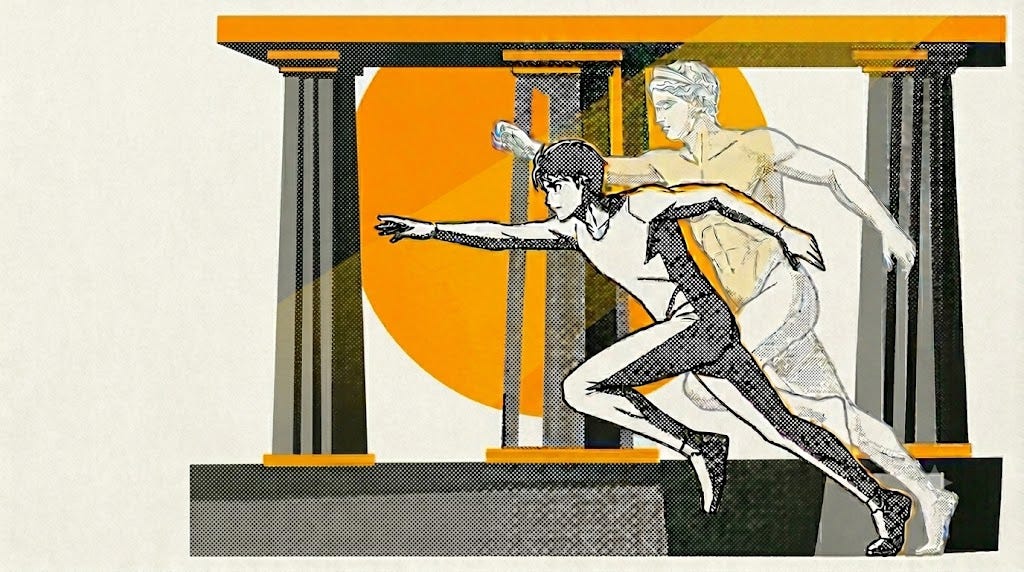
“Will the corporation,” asked artificial intelligence pioneer Herbert A. Simon in 1960, “be managed by machines?” Five years later came The Shape of Automation: For Men and Management, and five years after that, a curious rejoinder from a forgotten metaphysician: Frederick D. Wilhelmsen, known affectionately and universally as Fritz.
“Reasoning and Computers” (1970), a ten-page article in Thought—Fordham University’s quarterly review of culture and ideas—steered clear of the research agenda of Simon and company (into the epistemology of computational problem solving) to present a rival thesis. The processes and content of the human intellect, he insisted, entailed something much more and different than algorithms or even concepts alone could explain. While few public-facing academics of his time were more Catholic or indeed more Thomist than he, Wilhelmsen drew ably in his defense of human intellectual exceptionalism on the wryly apophatic assessment of David Hume that the artifacts of ideation could never deductively establish being – existence or is-ness. The affirmative judgment of what is—of what has being—expressed for Wilhelmsen the uniquely creative and existential culmination of the human intellect itself.
Being a good Thomist, however, Wilhelmsen reached at once for Aristotle to develop in his argument a demonstrative distinction between computer and human problem-solving. “The ‘quick wit’ of integration,” he promised—a faculty that Aristotle dubbed ἀγχίνοια—“is mankind’s best hope for mastering and ordering the new electronic revolution which otherwise threatens to drown us all in a sea of information.” (Should you sense an almost family resemblance in Wilhelmsen’s framing of the problem to that of Marshall McLuhan, the two indeed were friends and frequent correspondents; like McLuhan, Wilhelmsen was a willing coauthor, publishing The War in Man: Media and Machines (also 1970) and Telepolitics: The Politics of Neuronic Man (1972) with Jane Bret, a Montessori educator and mother of three who partnered with the Hungarian monks at the University of Dallas to co-found the city’s Cistercian Preparatory School.)
What we transliterate as agchinoia—and it is here where our story begins—is not a word of Aristotle’s own coinage. It is first found in the mouth of Socrates, who, in the Charmides, Plato has interrogate the titular lad on the true meaning of moderation or self-control (sophrosyne). In a scene not tonally out of place in some contemporary anime, the randy philosopher, it transpires, had had his own self-control tested by a glance at the popular and handsome Charmides: “I saw inside his cloak,” says Socrates, “and caught on fire, and was quite beside myself.” Following the implicit logic of this experience, Socrates attacks the traditional notion that self-control is best defined by the careful cultivation of inward stillness (hesychia), contrasting it directly with the “sharpness” or “readiness of soul” he calls agchinoia. “In all cases,” he ventures, “both in regard to the body and the soul, the qualities of swiftness and sharpness are clearly more beautiful than those of slowness and quietness,” concluding that sophrosyne “cannot be a sort of quietness, nor can the moderate life be a quiet one.”
Ironically, Aristotle, the more Thomist-friendly of the two towering Greeks, better reflected the swagger of the man of agchinoia. A flashy dresser with a fashionable hairstyle and rings plural bedecking his fingers, although a noted wife guy who considered pederasty a bad habit, his public morals attracted little of the attention, good or ill, directed at Socrates. Likewise, in Aristotle’s well-manicured hands, agchinoia is treated to something of a glow-up. In the Nicomachean Ethics, the term takes on more sharply tailored proportions—a sort of Odyssean skillfulness of nimble and supple intellect. Excellence in deliberation, says he, takes time, but agchinoia is an act of instantaneously good aim or sound conjecture, leaping over the reasoning process altogether to an accurate snap judgment about what or who is who or what they are. (In the Posterior Analytics, he defines the term more technically as involving an instant mental actualization of the middle term of a syllogism.) From here, agchinoia—compounded, after all, from the terms for grasping and understanding—gained its common English translations as “presence of mind,” or even “quick wit” in Wilhelmsen’s formulation.
In other words, in agchinoia we find a quintessentially Western phenomenon that holds out hope for human beings to distinguish themselves as subjects even from the computational objects deductively dominating more and more of what once was purely human space. The instantaneous exercise of judgment in the realm of what is and is not—shattering illusions and enabling agency all on the fly—would seem to be, as Wilhelmsen advertised it, a faculty still granted and reserved for human beings in an increasingly crowded epistemological landscape. The primal Western virtues explicated by Aristotle as virtues as such, human virtues, hinge on the not just immediate but intuitive and integrative faculty of agchinoia, which makes it possible, with neither deconstruction nor delay, to love and be loved in turn, to rule and be ruled in turn—in short, to live fully human, fully relational lives, rooted as must they be in accurate apprehension of true versus false identities, whether across the table or in the mirror.
Braving the weirding world
Most intriguingly, however, anyone familiar with peak anime’s most popular and powerful themes will see in agchinoia a virtuously agentic faculty strikingly similar to what drives both the plot mechanics and the character development of, to take the strongest example, the heroes stretched across the many decades and seasons of JoJo’s Bizarre Adventure.
For the uninitiate, the great multigenerational throughline of JoJo sees the Joestar family’s protagonists and their far-flung allies uniting for adventures forced upon them by the rise of an ever-changing and deeply malevolent cast of supervillains and henchmen. Both heroes and villains in the JoJoverse wield semi-incarnate manifestations of their inner spiritual states, spectrally mechanical entities with very physical capabilities known in the series as Stands. As each person is different, so is each Stand, with the exciting and perpetually fresh result that our heroes discover from day to day and confrontation to confrontation an unpredictable menagerie of lethally dangerous monstrosities, no two the same in their bizarrely superhuman capacities to surprise, defy, confuse, destroy, and, ultimately, kill. JoJo and friends gamely manifest their own unique Stands to meet the moment time and again. But what’s truly special about them is their excellence in bravely acting under immense pressure on their sudden insights into the inscrutable win conditions of every conflict—forming improbable chains of judgment that take into account the nature of their foes and the particularities of the often incredibly warped spacetime of each pitched battle and the larger war.
These holistic flashes of comprehensive, integrative insight—of defensively weaponized agchinoia—the Japanese call kiten (機転). Like agchinoia, kiten combines two related concepts: in place of grasping (agchi), triggering mechanism (ki); in place of mind (noia), turn or shift (ten). Kiten refers to the ability to sagaciously transform a situation on a dime, especially an importune one, turning a bewildering or overwhelming experience of disadvantage into a uniquely narrow yet wide-open opening onto victory. The initially incomprehensible and horrifying characters and attacks barraging JoJo’s heroes are overcome time and again through the startling application of kiten, the vile mysteries of each assailant’s identity, power, and weakness resolving suddenly in the heat of battle into elegant, complete, and sometimes hilariously shocking solutions.
Eternal victory
It would therefore stand to reason that, if agchinoia provides human beings a physically enduring and spiritually fulfilling edge even in a world growing phantasmagorically saturated with increasingly alien machinic forms, kiten might well do exactly that. But, in fact, what JoJo shows, quite deliberately on the part of its visionary creator Hirohiko Araki, is that kiten—while preeminent and foundational to courage and efficacy in defending against the greatest challenges posed in this world by outside enemies—is actually not enough to survive such attacks, even when all the data, so to speak, overwhelmingly predicts victory.
In JoJo’s fifth main story arc, Golden Wind, the heroes’ journeys demonstrate that kiten can only truly be mastered and embodied when one has internalized a quantum of holistic wisdom that necessarily stands somewhere outside kiten itself. One must grasp that the lethal disorientation imposed by outside enemies is ultimately a secondary obstacle to triumphant agency; the deepest threat is the deadly confusion sown by the internal enemy of spiritual enslavement. Fully activating one’s humanity demands a lived-out free willingness to sacrifice oneself utterly for those one loves. Endurance, calculation, and sudden insight, no matter how powerful, can’t break the chains of spiritual bondage. Within those chains, ultimate defeat —not just yours, but your friends’, your family’s, perhaps millions of innocents—is certain.
The perfection of kiten is found in its in-the-moment realization of its own incompleteness, in its embrace of self-sacrifice as the win condition over the deepest foe that opens onto eternity. The golden wind of spirit passes from friend to friend, life to life. “Righteous actions born of truth shall never be destroyed,” declares the arc’s protagonist in its final act. “My friends may have perished, but their actions and wills have not been destroyed. So, are your actions born of truth, or are they merely superficial, born of evil?” Though it’s not an explicitly Aristotelian or Christian message, Wilhelmsen, for one, would have grasped the resonance at once.
Americans at large, who love little more than the feeling of trust that arises from their directly experiencing a truth for themselves, therefore find in distinctively Japanese work like JoJo an engrossing invitation to connect for themselves the spiritual dots traced out by, for instance, Araki. Americans love to propagandize and hate to be propagandized, a feeling probably at least twice as strong in the case of proselytization; Japanese culture, especially anime, provides them a way of hearing what they feel they need to hear without demanding the humiliation of overt supplication. To the strange American soul, it’s a safely alien presentation that lets down the prideful American guard through the dazzling performance of what is ostensibly mere entertainment.
The rediscovery of America
And as the stakes hockey-stick upward apace in the acceleration debate, Americans do need to feel safe enough to approach the fullness of the spiritual truth concerning human triumph in a technologized age. For several deep-seated reasons, many millions of people struggle to find that feeling in recourse to modern religiosity, which often feels tacky, cringy, smothering, lecturing, performative, and phony. The dynamic is driving more younger Americans toward the more ancient of the Christian churches, but it’s also fueling an increase in participation in cults or cultlike organizations, including technological ones. The urge to derive spiritual satisfaction from a religion or a church of tech is substantially motivated by a desire to partake of what’s seen to be an objective upgrade from our base, given reality. But human reasoning, as Herbert Simon introduced to his discipline, is typically “bounded” by high time preference, leading to decisions that merely satisfy short-term criteria instead of fully weighing costs and benefits for the sake of optimality. The anxious “if you can’t beat ‘em, join ‘em” attitude driving worship of technology and seeking cyborg deliverance can be released by a more contemplative posture more conducive to flashes of deeper spiritual and psychological insight – psychology, after all, being reasoning about the soul (psyche).
Japanese culture holds out to Americans the promise of a future where they can have both well-developed religion and technology without having to kneel before a clerical or a cyborg theocracy. JoJo’s Stands metaphorically epitomize the drive to achieve superhumanity by engineering virtual powerhouses built to dominate human spacetime—near-autonomous demigods with reality-distortion fields capable of turning most people mentally and physically to mush. JoJo’s heroes insist that only kiten/agchinoia, in service of spiritual sacrifice, can preserve human life and human identity in such a world.
It’s a vantage point from which cagey or cynical Americans might rediscover the application of ancient Christian faith to the same problem set —an opportunity some might take after long and quiet contemplation, some might seize in a flash of comprehensive insight, and some might never opt into, content to hover in the realm of artful fantasy. In each case, the contemporary patrimony of Japanese culture holds out special charms. Westernized, but not too Westernized. Technologized, but not too technologized. Pious but not too pious, decadent but not beyond repair. The ordeal of debating the identity and the destiny of the West ebbs to a tolerable degree in an Eastern context that isn’t (as in the case of China) so fully other. It becomes possible to conceive of a plausible future where humans and machines need neither turn against each other nor turn into each other.