



This post is coming out in tandem with Soham’s interactive economic model of wave-powered data centers. This post explains why we think ocean compute matters, assuming that it is feasible. If you are curious about how ocean compute works and whether it makes economic sense, we highly encourage you to check out the model!
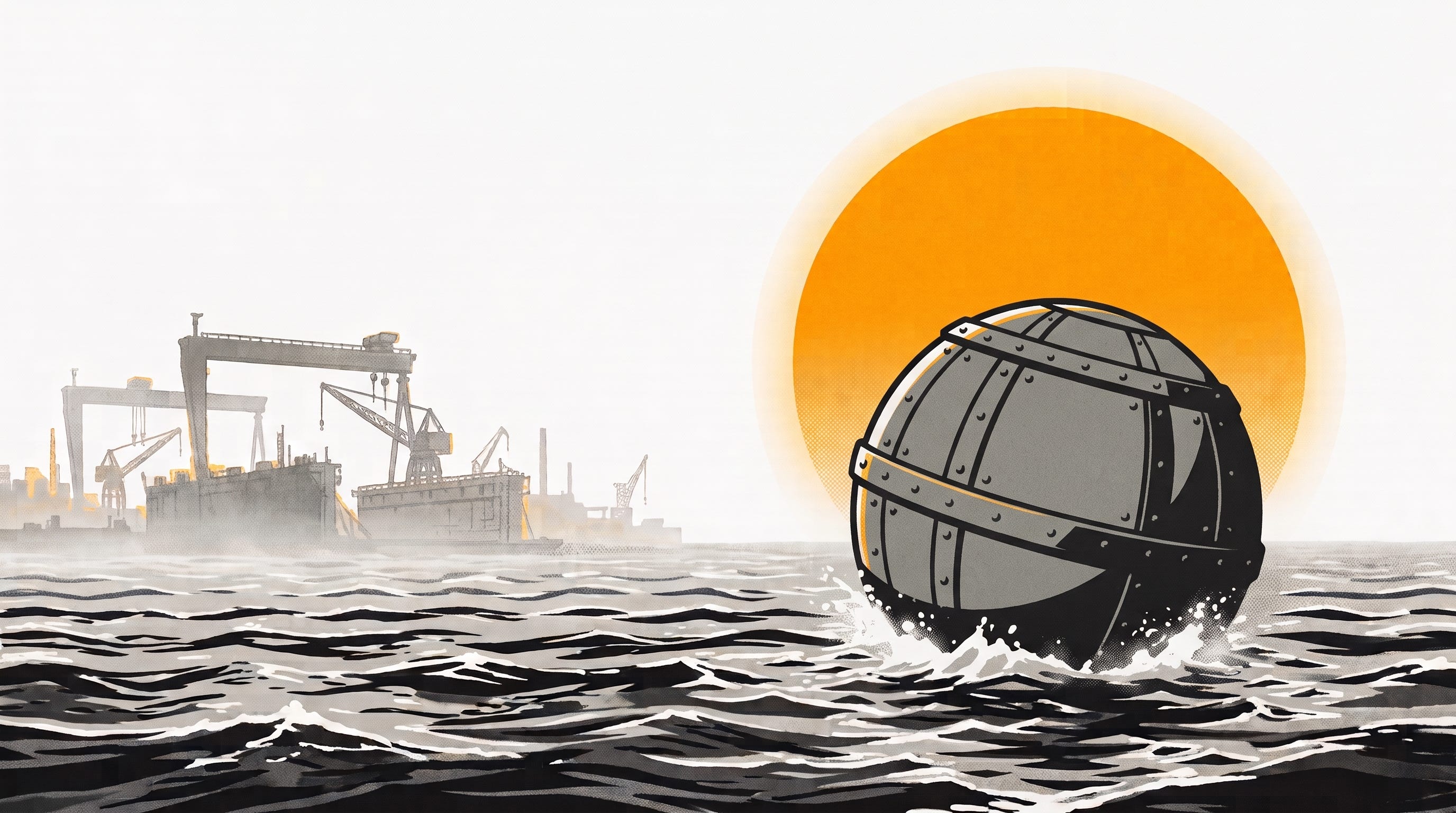
The next chapter of the ocean economy may grow out of the bones of America’s industrial past. Eighty years ago, the shipyards of Vancouver, Washington helped feed the country’s enormous wartime hunger for new vessels, churning out 141 ships over the span of World War 2, including Liberty-class cargo ships. The Liberty ship is often cited as a feat of mass production almost without precedent, with American shipyards collectively constructing more than 2,700 during the war. It is hard to look back at the extraordinary scale, pace, and ingenuity of U.S. wartime output, then at the diminished state of American ship production today, without feeling a sense of lost industrial glory.
But today, these same shipyards offer a glimmer of hope. Inside this storied industrial complex, the welders at Thompson Metal Fab are at work on machines that could unlock the ocean as a vast new physical substrate for American computation: Panthalassa’s wave-powered computing nodes. As laid out in a previous Ansible article, Panthalassa is a startup building floating data centers. They produce wave energy converters that power AI workloads onboard using energy from the tempestuous open ocean.
A few months ago, I thought of Panthalassa as a clever energy moonshot that could pose questions about governing superintelligence incubated in international waters. Today, as I release a techno-economic model that assesses whether wave energy can cheaply and effectively meet rising AI-driven energy demands, I have come to see Panthalassa as a foundational building block for a much larger ocean economy.
We need to widen our imaginative aperture to consider the role of the ocean in AI. Beyond a brief mention of offshore data centers in the viral scenario AI 2040: Plan A—where data centers move to international waters out of geopolitical necessity rather than on the economic merits—we mostly conceptualize AI powered by enormous suburban data centers that perhaps eventually launch into orbit. Silicon Valley’s visionaries tend to look upward. We have become increasingly comfortable imagining space as a new geography for industry. But there is comparatively little curiosity about what expanding across, and beneath, the last frontier that still exists on Earth would mean. If my model is right, the ocean is poised to become a major center of American computation. More importantly, this same cheap, renewable energy could make the ocean a crucible for cutting-edge science and autonomous industry.
Why the ocean will be critical for AI
As the model shows, waves contain enormous amounts of usable, consistent energy which Panthalassa can harvest with cheap and simple machinery that incurs surprisingly low maintenance costs. As a result, their nodes enjoy a very low levelized cost of energy (LCOE) and a high capacity factor—a remarkable combination for a source of renewable energy. The low physical capital costs and parsimonious design mean that it is possible to predictably and quickly scale up capacity.
The problem is that the people and industries that use energy are located thousands of miles away on land. Carrying the power thousands of miles would be a logistical nightmare. So, Panthalassa found the most lucrative, geographically-adaptable industry hungry for cheap energy sources with low time-to-power: AI compute. AI inference in particular is an unusually good fit. Unlike frontier training runs, inference can be distributed across a geographically dispersed network (Panthalassa’s nodes are not currently physically connected to one another, and use Starlink to send their workloads to shore). Test-time scaling is core to improving reasoning by letting models search and deliberate longer, while agents compound this computational demand further by stringing together many model requests and tool calls to complete a single task. Luckily for Panthalassa, these are location-flexible workloads because they occur in contexts where throughput and cost matter more than millisecond-level latency—this is especially true for long-running agents, coding, research, and other asynchronous tasks.
Wave-powered inference could also support ambitious AI policy proposals. Evaluating models and continuously monitoring agents will not be cheap. Frontier capability evaluations can be enormous on an individual task basis, consuming billions of tokens and requiring an inference budget in the tens of thousands of dollars. Building privacy-preserving agentic infrastructure, from agent IDs to proof of humanity systems, will likely require computationally expensive attestation systems and cryptographic proofs like zk-SNARKs. Governing a world with transformative AI is going to require a lot of energy. Serendipitously, Panthalassa spent years developing a strange form of energy just as an equally strange set of challenges and use cases have emerged.
Why the implications are much larger
While the AI future offers some of the best use cases, LCOE is use-agnostic. This means Panthalassa has not just found a cheap way to power data centers, but a generic way to provide cheap, reliable power in the open ocean. A core reason why offshore industry is massively undeveloped is that it pays what might be called an ocean distance tax. Sustaining a human worker at sea is costly: you have to supply food, shelter, safety systems, and emergency support from scratch in an extremely remote location. It’s also psychologically grueling enough that you’d need to rotate workers out regularly, adding even more costs. Robots come with their own problems, energy and maintenance being first and foremost, but also bandwidth and latency: the communications infrastructure is sparse enough that you can’t just remotely control them. This creates a vicious cycle. Because operating far offshore is expensive, there is no reason to build persistent infrastructure in the ocean; because little infrastructure exists there currently, nearly every new activity is a bespoke, complex mission, keeping costs high.
Essentially, to break this cycle, ocean industry requires autonomous systems that run locally or use edge compute running on cheap power. To be fair, there are many other reasons the ocean is inhospitable to industry today—corrosion, biofouling, storms, and maintenance, to name a few—but cheap energy is key to surmounting many of these challenges. More abundant power means more capable onboard compute, which means better sensing and monitoring that can reactively alter a vessel’s course or catch damage early, which could mean more resilient infrastructure. In other words, cheap energy is certainly not a sufficient condition for a large offshore economy, but it does make many of the other constraints cheaper to manage.
I am speaking at a deliberately high level here, and I am hardly the first person to make this argument. Will O’Brien and Packy McCormick’s excellent essay The Great Blue Frontier takes on the question of ocean industrialization more robustly, describing an “ocean stack” that includes layers of interlocking technologies that make each of the other layers more useful and cheaper. The stack spans from autonomous vehicles to energy installations like Panthalassa. Rather than describe this same ecosystem, I want to end with a taste of the interesting applications that cheap, abundant wave energy would allow.
Ocean Science
Studying the ocean is difficult. It involves sending an expensive instrument somewhere very harsh and remote, desperately collecting whatever data you can before its energy runs out or its lifespan expires, then transmitting the data to shore for analysis. Persistent offshore power would make something resembling a network of ocean probes possible. Autonomous vehicles could recharge at sea using floating wave energy converters, run powerful sensors for much longer periods of time, and process observations locally rather than trying to send large amounts of raw imagery, sonar, or biological data through constrained communications links. Eventually, autonomous systems may be capable of noticing something scientifically interesting—a strange organism, chemical signal, or geological formation—and deciding on their own to investigate further. Versions of this are being attempted, and could benefit from Panthalassa’s cheap power: DOE-backed researchers are developing wave-powered docks that recharge and communicate with autonomous underwater vehicles (AUVs), while NOAA is field-testing AI aboard autonomous vehicles so they can identify and classify deep-sea animals in real time.
Offshore industry
When it comes to offshore production, oil and gas have already demonstrated that, if the extracted resource is valuable enough, we will take on the risk and cost of moving enormous amounts of industrial machinery into the middle of the ocean. Cheap power and autonomy lower the value threshold that an activity has to clear before it makes sense to bring it out to sea. Consider seabed minerals. Currently, deep-sea mining proposals already plan to separate sediment and dewater nodules aboard the production vessel before shipping them to shore because it doesn’t make sense to pay for transporting water and waste material across the ocean. However, we can lower transport costs by shedding dead weight and make deep-sea mining more attractive by pushing much of the value-adding industrial chain offshore—such as sorting, crushing, concentrating, or perhaps eventually doing parts of metallurgical processing.
Aquaculture
Offshore power may even secure and strengthen our food systems by supercharging aquaculture. Seth Dowell’s recent piece in Palladium on China’s “blue granary” describes how China is pioneering mobile fish-farming ships, enormous offshore cages, marine ranches, underwater inspection drones, and automated feeding and monitoring systems. Of course, China is not building these far into the open ocean yet, where marine life is generally much less dense than in coastal waters or lakes. But advanced fish farming could effectively create productive ecosystems where few existed before, seeding managed populations and sustaining them with automated feeding and oxygenation, monitoring, and disease control. This last point is crucial because many aquaculture ventures currently struggle with fish welfare and disease. The preventative measures like automated delousing and better water circulation are currently very energy intensive. Pumping alone currently consumes the plurality of site energy in aquaculture farms. Thus, cheap ocean energy would not make aquaculture merely larger, but more instrumented, automated, controlled, and humane.
Conclusion
The future is difficult to predict, and I would suspect that the most consequential uses of abundant offshore power will be ones I have not named and cannot imagine. However, the possibility that this technology could reshape computation, critical industries, food systems, and scientific activity is plausible enough to deserve serious attention. At FAI, our work begins from the premise that technological change and statecraft cannot be treated as separate endeavors: we must recognize emerging technological frontiers, understand what they could mean for national power and prosperity, and shape the conditions under which they develop. We think the ocean may be one of those frontiers. This model is just our first attempt to understand its economics, and we plan to keep studying what an increasingly industrialized ocean could mean for America. Stay tuned.